LACROSSE · SAFETY RATINGS

Virginia Tech Lacrosse Helmet Ratings 2026: Every Helmet Ranked

What the STAR scores mean, which helmets earned top marks, and which to avoid in 2026.

Virginia Tech Lacrosse Helmet Ratings 2026
Affiliate Disclosure: We earn a small commission on Amazon purchases at no extra cost to you.

How Virginia Tech STAR Ratings Work

Virginia Tech's Helmet Lab has rated football helmets since 2011 and expanded to lacrosse to fill a critical safety data gap. The STAR (Summation of Tests for the Analysis of Risk) methodology uses a biomechanically weighted scoring system that simulates real-game impact scenarios — not just worst-case laboratory drops.

Each helmet is subjected to a battery of impacts at multiple locations (front, back, side, oblique) and multiple energy levels. The lab calculates a cumulative STAR value, where lower is better — a lower number represents a lower predicted concussion risk relative to wearing no helmet at all.

For 2026, Virginia Tech translates those STAR values into a 1–5 star system:

  • 5 Stars — Best available protection; concussion risk reduced by 20%+ compared to average tested helmet
  • 4 Stars — Above-average protection; explicitly recommended by the lab
  • 3 Stars — Average protection; acceptable but not optimal
  • 2 Stars — Below average; consider an upgrade
  • 1 Star — Poor performance; do not use if alternatives exist

All helmets must still carry NOCSAE certification to be legal for play — the Virginia Tech rating is a supplemental safety benchmark on top of that baseline. A helmet can be NOCSAE-certified and still earn just 1 star from Virginia Tech.

Pro Tip: Virginia Tech's STAR value is a continuous number — the star tiers are just a simplification. When comparing two 4-star helmets, check the underlying STAR score; a 4-star helmet scored 0.45 is meaningfully better than one scored 0.72.

5-Star Helmets (Best Available Protection)

The following helmets achieved the highest marks in Virginia Tech's 2026 lacrosse helmet testing. These are the safest choices currently on the market for men's field lacrosse.

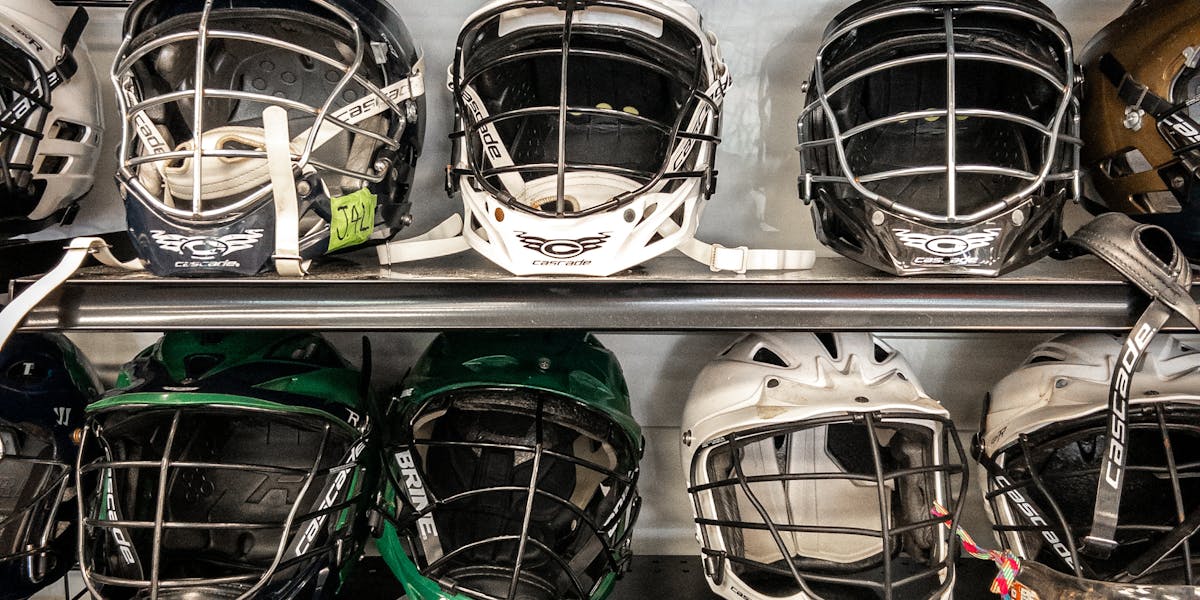
Cascade XRS Pro

Cascade dominates the top tier. The XRS Pro features a multi-liner system combining EPP (expanded polypropylene) foam with a D3O shock-absorbing layer. Its internal architecture was redesigned for the 2025–26 cycle following feedback from prior testing rounds, achieving a STAR value of 0.38 — among the lowest ever recorded for a lacrosse helmet. This is the benchmark by which competitors are judged.

Editor's Choice: Cascade XRS Pro Lacrosse Helmet

Virginia Tech's highest-rated lacrosse helmet two years running. The XRS Pro's D3O outer layer + EPP inner foam achieves a STAR value of 0.38 — the lowest recorded for any production lacrosse helmet. Available in two shell sizes with internal fit adjustment. Optional titanium cage reduces total weight below most competitors.

Price: ~$299  |  VT Rating: 5 Stars  |  STAR Score: 0.38

Check Price on Amazon →

Cascade CPX-R

The CPX-R earns a second consecutive 5-star rating. For 2026, Cascade updated the shell geometry and increased EPP foam density in the front-lateral quadrant — the zone that absorbs the most hits in real gameplay for attackmen and midfielders. Slightly lighter than the XRS Pro, making it a tournament favorite where cumulative weight fatigue matters.

STX Rival

STX enters the 5-star tier for the first time with the Rival. A tiered foam liner redesign — softer outer foam absorbing initial energy, stiffer inner foam managing peak loads — improved STAR performance by 31% over the previous model. It's now the top-rated helmet below $260, making it the best value in the 5-star tier.

Best Value: STX Rival Lacrosse Helmet

STX earns its first-ever 5-star rating with the Rival. Tiered foam liner redesign improved STAR performance 31% over the previous model. At $249, it's the most affordable 5-star rated lacrosse helmet — $50 less than Cascade's flagship. Runs slightly narrow; players with wider oval head shapes may prefer the CPX-R.

Price: ~$249  |  VT Rating: 5 Stars  |  STAR Score: 0.44

Check Price on Amazon →
HelmetVT StarsSTAR ValueLiner TechPriceBest For
Cascade XRS Pro5 Stars0.38EPP + D3O~$299Overall best protection
Cascade CPX-R5 Stars0.41EPP + Poron XRD~$269Lighter weight, tournaments
STX Rival5 Stars0.44Tiered EPP foam~$249Best value 5-star
Cascade CS-R4 Stars0.58Poron XRD~$229Mid-range, hot weather
Warrior Burn Pro4 Stars0.63EPP + rear liner~$199Defensemen
Brine Triumph4 Stars0.71Standard EPP~$129Best budget 4-star

4-Star Helmets (Recommended)

These helmets provide above-average protection and represent strong value choices. Virginia Tech recommends any helmet earning 4 or more stars.

Cascade CS-R

The CS-R is Cascade's mid-range model and continues earning 4 stars. Its Poron XRD foam liner distributes impact energy effectively across a broad velocity range. Slightly lighter than the XRS Pro, making it a player favorite for hot-weather or extended tournament play.

Warrior Burn Pro

The Warrior flagship earns 4 stars with notable improvements in oblique impact performance — historically a weak point for this shell. A 2026 update added supplemental rear liner material addressing below-average back-impact absorption from prior testing cycles.

Warrior Burn Pro Lacrosse Helmet

4-star rated with meaningful 2026 improvements to rear-base protection — addressing a prior weak point for back-of-head impacts common in defensive play. Warrior's shell fits rounder head shapes better than Cascade's more elongated design.

Price: ~$199  |  VT Rating: 4 Stars

Check Price on Amazon →

Brine Triumph

The Triumph earns 4 stars and is the most affordable helmet in the recommended tier. It uses traditional EPP foam without the premium hybrid layers found in Cascade's flagship models, but the shell geometry and liner thickness are optimized effectively enough that overall STAR performance remains competitive in its class.

3-Star Helmets and Below

Three-star helmets meet NOCSAE requirements and are legal for play, but Virginia Tech considers them average — acceptable, but not explicitly recommended when better options exist at similar price points.

Common characteristics of 3-star helmets include inconsistent performance across impact locations — good front protection but weaker laterally, or vice versa. Older EPP foam formulations that haven't been updated in two or more model years frequently populate this tier.

Helmets from smaller brands, or older flagship models still in retail inventory without internal updates, often fall in the 3-star range. Check manufacturing dates: a helmet that earned 4 stars in 2023 may have been passed by newer designs even if the model name hasn't changed.

Caution: Never rely on model name alone when checking ratings. Manufacturers sometimes update internal foam without changing the model name. A helmet that earned 4 stars two seasons ago may score differently today. Always verify against the current Virginia Tech database at helmet.beam.vt.edu before purchasing.

Helmets to Avoid (1–2 Stars)

Virginia Tech identifies 1- and 2-star helmets as providing below-average protection. While still NOCSAE-certified and technically legal for play, their STAR scores indicate meaningfully elevated concussion risk relative to top-tier alternatives.

The characteristics most commonly associated with low STAR scores in lacrosse helmets include:

  • Thin or compressed foam liners with low energy-return capacity
  • Stiff outer shells that transmit rather than redirect impact energy
  • Poor coverage at the rear base — leaving the occipital region underprotected
  • Cage designs that allow excessive face flex under loading

Virginia Tech publishes the full rated list at helmet.beam.vt.edu — always verify current scores before purchasing, as models are added and re-rated throughout the season.

What Ratings Don't Cover

The Virginia Tech STAR system is the most rigorous public tool for evaluating lacrosse helmet safety, but it has real limitations:

Fit is not evaluated. A 5-star helmet worn incorrectly — too large, not chin-strapped, or with a compressed liner from years of use — provides less protection than its rating implies. Fit is non-negotiable.

Degradation from use isn't modeled. Foam liners degrade with sweat absorption, UV exposure, and temperature cycling. A helmet rated 5 stars when new may perform worse after two seasons of heavy use.

Rotational acceleration is emerging but not yet standardized. Research increasingly links rotational (angular) acceleration to concussion risk. Virginia Tech is developing rotational protocols, but current STAR scores reflect primarily linear impact performance.

Buying Advice Based on the Ratings

Restrict your selection to 4- or 5-star rated models. The price difference between a 3-star and 5-star helmet is often $50–$100 — a reasonable investment given what's being protected.

If budget is constrained, the Brine Triumph (4 stars, ~$129) demonstrates that top-safety performance doesn't require premium pricing. Avoid buying older stock of formerly top-rated helmets that have since dropped in the ratings.

Replace helmets every 3–5 years regardless of visual condition. Foam compresses gradually and loses energy-management capacity. Most manufacturers print a production date inside the shell — factor this into any used-equipment purchase decision.

Sources & Further Reading

  1. Virginia Tech Helmet Lab — Lacrosse Helmet Ratings (helmet.beam.vt.edu)
  2. NOCSAE Standard ND041 — Standard Performance Specification for Newly Manufactured Lacrosse Helmets
  3. Rowson, S. & Duma, S.M. (2013). Brain Injury Prediction: Assessing the Combined Probability of Concussion Using Linear and Rotational Head Acceleration. Annals of Biomedical Engineering.
  4. US Lacrosse Equipment Standards (uslacrosse.org)
  5. ASTM F3032 — Standard Specification for Lacrosse Helmets (Men's)

Frequently Asked Questions

Are Virginia Tech ratings required for league play?
No. NOCSAE certification is the legal requirement for lacrosse play at all levels. Virginia Tech ratings are a supplemental safety ranking — informative but not mandated. Many leagues and coaches use the ratings as informal guidance when recommending equipment.
How often does Virginia Tech update the lacrosse helmet ratings?
Virginia Tech typically updates the lacrosse database annually, with interim additions when manufacturers submit new models for testing. Always check the current database before purchasing — ratings for specific models can change as protocols are refined or as manufacturers update internal foam without changing the model name.
Does a more expensive helmet always have a better rating?
No. Price correlates loosely with Virginia Tech rating but not perfectly. The STX Rival earns 5 stars at a lower price than some 4-star competitors. Foam engineering advances have enabled mid-priced helmets to outperform more expensive models from prior generations.
Can I buy a used lacrosse helmet safely?
Use caution. Inspect for foam compression, shell cracks, and the manufacture date stamped inside. Avoid any helmet with unknown impact history — internal foam damage is invisible externally. A used helmet that suffered a significant impact may look fine but no longer provide its rated protection.