The "Chin Height" Myth
Walk into any rental shop and they'll size your snowboard by standing it next to you — chin height for beginners, nose height for advanced. This method has survived for decades and it's wildly oversimplified.
A 5'10" rider who weighs 140 lbs and a 5'10" rider who weighs 210 lbs should NOT be on the same size board. Neither should a 5'10" park rider and a 5'10" powder chaser. Weight, boot size, and riding style matter as much as (or more than) height.
Snowboard company Ride's engineering team, Burton's board designers, and independent reviewers like The Good Ride (Ryan Knapton, former pro snowboard instructor and one of the most trusted review voices in snowboarding) all emphasize that weight is the primary sizing factor, not height.
Size by Weight (The Better Method)
| Rider Weight (lbs) | Freestyle/Park (cm) | All-Mountain (cm) | Freeride/Powder (cm) |
|---|---|---|---|
| 100-120 | 138-143 | 142-147 | 146-151 |
| 120-140 | 143-148 | 147-152 | 151-156 |
| 140-160 | 148-153 | 152-157 | 156-161 |
| 160-180 | 153-157 | 157-161 | 161-165 |
| 180-200 | 155-159 | 159-163 | 163-167 |
| 200-220 | 157-162 | 162-166 | 166-170 |
| 220+ | 160+ | 165+ | 169+ |
These ranges overlap intentionally — your riding style determines where in the range you land.
How Riding Style Affects Size
Freestyle / Park (Size Down 2-4 cm)
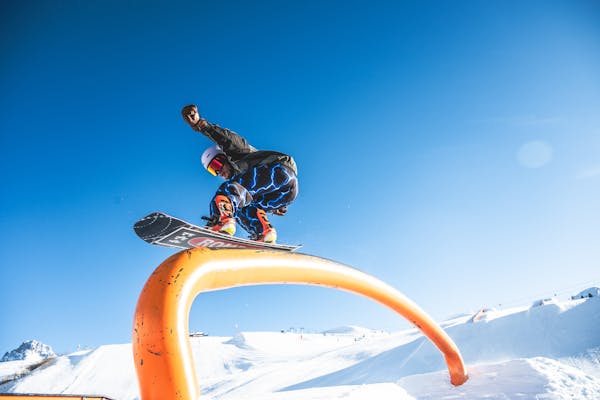
Shorter boards are lighter, easier to spin, more maneuverable in the park. If you're primarily riding terrain parks, halfpipes, and jibs, go toward the smaller end of your weight range.
All-Mountain (Size Right in the Middle)
All-mountain boards are the default for most riders — groomed runs, some trees, occasional powder. Size to the middle of your weight range.
Freeride / Powder (Size Up 2-4 cm)
Longer boards provide more float in powder and more stability at speed. If you chase deep days and open bowls, size toward the larger end or even above your weight range.
Board Width: The Factor Most People Ignore
Board width matters as much as length — and it's determined by your boot size. If your board is too narrow, your toes and heels extend past the edges (called "toe drag" and "heel drag"), catching in the snow during carves. Too wide, and you can't transfer pressure to the edges effectively.
| Boot Size (US Men's) | Board Width Needed |
|---|---|
| Under 8 | Standard (24.4-25.0 cm waist) |
| 8-10 | Standard to Mid-Wide (25.0-25.6 cm) |
| 10-11.5 | Mid-Wide to Wide (25.5-26.0 cm) |
| 12+ | Wide (26.0+ cm) |
Board Profile: Camber vs. Rocker vs. Hybrid
Profile describes the shape of the board when you look at it from the side:
Camber (Traditional)
Board arches up in the middle, touching the snow at tip and tail. When you weight it, the camber presses into the snow creating maximum edge grip and pop. Best for: aggressive carvers, park riders, hardpack/icy conditions.
Rocker (Reverse Camber)
Board curves up like a banana — elevated at tip and tail, touching at center. Provides loose, surfy feel, excellent float in powder, very forgiving on catches. Best for: beginners (very catch-resistant), powder days, playful riding.
Hybrid Profiles (Most Popular)
Combinations of camber and rocker. The most common modern designs:
- Rocker-Camber-Rocker: Rocker in the nose/tail (catch-free, float), camber underfoot (edge grip, pop). The best all-around profile for most riders.
- Flat-Rocker: Flat underfoot with rocker in the nose. Stable and predictable. Good for beginners transitioning from full rocker.
- Camber-Rocker-Camber: Aggressive hybrid. Camber zones for grip, rocker at the center for forgiveness. Advanced riders.
Flex Rating
Snowboard flex is rated on a scale of 1-10 (soft to stiff). There's no universal standard — it varies by brand.
| Flex Rating | Best For | Feel |
|---|---|---|
| 1-3 (Soft) | Beginners, park/jib, playful riding | Forgiving, easy to butter and press |
| 4-6 (Medium) | All-mountain, most riders | Balanced response and forgiveness |
| 7-10 (Stiff) | Aggressive carving, high speed, powder | Maximum edge hold, less forgiving |
Recommended Boards by Style
Best All-Mountain Board
Best Beginner Board
Best Freestyle/Park Board
Common Mistakes
Sources & Further Reading
- Knapton, R. "How to Size a Snowboard." The Good Ride, 2025. thegoodride.com
- Burton. "Snowboard Sizing Guide." burton.com
- Evo. "How to Choose a Snowboard." evo.com, 2025.
- TransWorld Snowboarding. "Good Wood Board Test 2025." transworld.net
- Ride Snowboards. "Board Design and Sizing." ridesnowboards.com
- Whitelines Snowboarding. "Snowboard Sizing: The Complete Guide." whitelines.com, 2025.