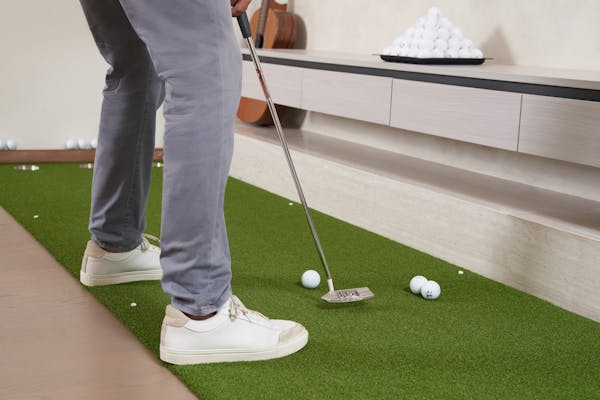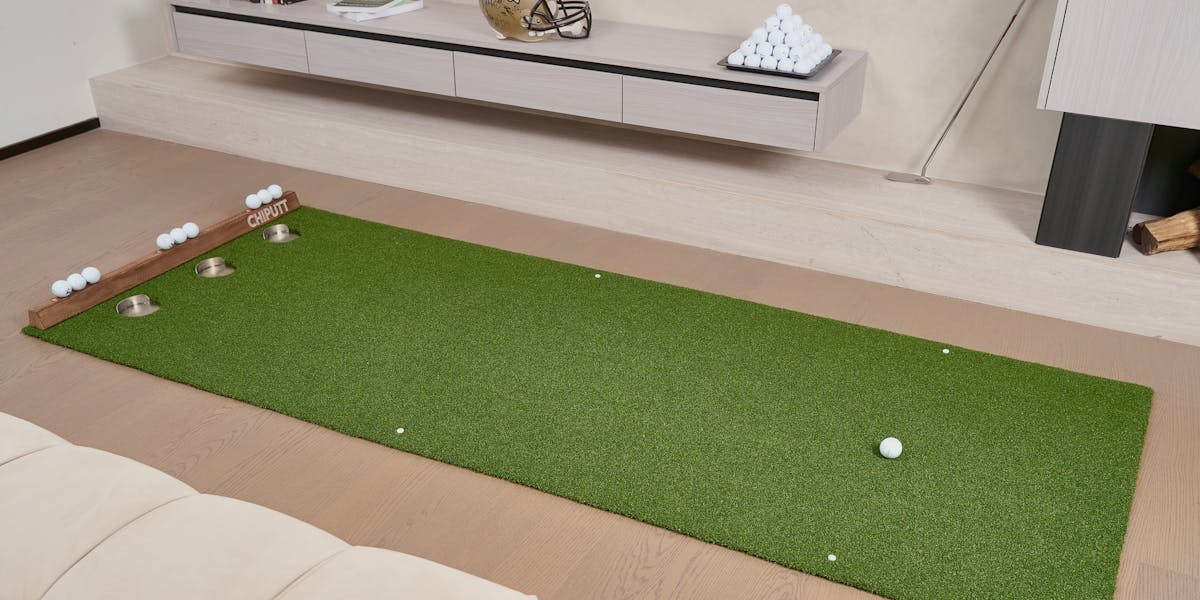
Does Wellputt work on carpet? Fast answer
A putting mat can work on firm low-pile carpet, but plush carpet changes roll and start-line feedback. Choose the mat by surface first, then length and feedback.
Official Wellputt check: reviewed June 18, 2026. The current 13ft Performance page lists a $189 price, 13ft length, 10/11.5ft stimp surface, app drills, and a latex backing for grip. That supports dense, level carpet; it does not make plush carpet behave like a hard floor.
| Reader | First Pick | Why It Fits | Buy Zone |
|---|---|---|---|
| Low-pile carpet | Wellputt 13ft | Best when the room supports a longer, flatter practice lane; current official list is $189. | Strong near $170 |
| Apartment setup | PuttOut Premium | Good feedback with easier storage than a larger indoor green. | Watch $200-$230 |
| Starter mat | Callaway 9ft | Low-cost entry for face control and daily reps. | Good under $45 |
| Serious room | Indoor green panel | Worth it only when space and permanent setup are available. | Compare shipped price |
| Plush carpet | Use a firmer base | The mat choice matters less if the floor under it moves. | Test return terms |
Quick answer: Wellputt works best on firm low-pile carpet.
Use Wellputt on a dense, level carpet or a hard floor. If the room has plush carpet, add a firm board or choose a smaller mat that can sit on a stable base, because the floor will change roll speed more than the mat.
Wellputt on carpet: buy by surface stability first.
Low-pile carpet can work if the mat lies flat and the stance area does not compress. Plush carpet needs a firmer base or a different setup before the product choice matters.
How this putting mat review is organized
This page now follows the TSP gear-review system: quick winners, room-size fit, realistic buy zones, tradeoffs, and links into the broader golf review hub.
Golf Practice Smart Buying Path
Use this putting mat ranking as the product shortlist, then compare the methodology, practice-aid cluster, and current deal path before buying.
If you searched "does Wellputt work on carpet," start with surface stability
This refresh answers the carpet-fit query first and keeps Wellputt, PuttOut, Callaway, and indoor-green paths separated by room and practice goal.
Putting mat decision matrix
Use the surface and room-length split before paying for a bigger mat.
Quick Picks
- Best budget mat: Callaway 9ft Putting Mat - simple ball return, alignment guides, easy storage. View official product page
- Best serious practice mat: Wellputt 13ft - true roll, printed drills, strong choice for low-pile carpet or hard floors. Shop Indoor Golf Check Amazon
- Best feedback mat: PuttOut Premium 14ft - longer surface with demanding speed and direction feedback. View official product page
Putting mat price watch: realistic buy zones
Putting mats swing hard by length and bundle. Watch the shipped price, not just the product price, and avoid mystery-brand mats unless the return window is clear.
Why Practice Putting Indoors?
Putting accounts for roughly 40% of your total strokes in an average round. Yet most golfers spend the vast majority of their practice time on full swings. A quality putting mat lets you work on your stroke mechanics, speed control, and face angle every day — no driving range trip required.
Research from amateur golf studies consistently shows that regular short-game practice produces faster handicap reduction than equivalent time spent on full swings. If you can putt 20-30 minutes per day, you will make more putts within 10 feet. The equipment required is minimal: a mat, a putter, and a few balls.
What to Look For in a Putting Mat
Not all putting mats are created equal. Here are the specifications that separate practice-grade mats from novelty items:
Roll quality: The surface should produce a true, consistent roll that mimics a real putting green. Low-quality mats have seams, wrinkles, or inconsistent pile that create unpredictable breaks. Look for mats with a uniform, tightly woven fiber pile.
Surface speed (Stimpmeter equivalent): Tour greens run 10-14 on the Stimpmeter. Most indoor mats run 8-11. Faster mats (10+) are better for developing a touch-based stroke; slower mats can reinforce too-aggressive tempo.
Length: Minimum 9 feet for meaningful distance practice. 12-15 feet is ideal for developing long-range lag putting speed. If space allows, longer is almost always better.
Width: Narrow mats (12-16 inches) limit you to straight putts. Wider mats (24+ inches) allow you to practice angled approaches and multiple cup positions.
Cup design: A proper cup should return the ball or have a backstop so you're not constantly walking to retrieve. Electronic ball return systems add convenience but also add cost.
| Feature | Budget (<$50) | Mid-Range ($80-$200) | Premium ($200+) |
|---|---|---|---|
| Surface Speed | 6-8 | 9-10 | 10-12 |
| Length | 6-9 ft | 9-12 ft | 10-20 ft |
| Width | 12-16 in | 16-24 in | 20-36 in |
| Break Simulation | No | Rare | Often included |
| Cup Return | Manual | Manual/spring | Spring or electronic |
| Alignment Guides | None | Basic lines | Full alignment system |
Best Budget Putting Mat: Callaway Putting Mat
The Callaway 9-foot putting mat ($39) is the best entry-level option for golfers who want to try indoor putting practice without a significant investment. The surface is smoother than most budget mats, the ball return works reliably, and the alignment guides printed on the surface are genuinely useful for checking path and face angle.
It won't simulate course conditions closely, but as a tool for practicing the mechanical fundamentals of your stroke — face angle, tempo, path — it gets the job done at minimal cost. The mat rolls up and stores easily, which matters if you don't have dedicated space.
Best Mid-Range: Wellputt 13ft Putting Mat
The Wellputt 13-foot mat ($149-$179) is the most recommended mid-range option among golf instructors for a reason: the surface replicates Stimpmeter 10 green speeds accurately, the multiple cup positions allow for varied practice, and the printed alignment grids help develop a repeatable setup routine.
Wellputt mats are used by PGA Tour instructors and are featured in numerous professional teaching facilities. The mat is heavy enough to lie flat without curling, and the fiber quality is noticeably above typical Amazon mats. If you're going to practice consistently, this is the price point where quality becomes meaningfully better than budget options.
If you are wondering whether Wellputt works on carpet, the short answer is yes on low-pile carpet, but it rolls truest on a hard, level floor or a dense rug pad. On plush carpet, use a thin backing board under the mat to keep the surface flat and prevent the pile from adding unwanted break.
Wellputt 13ft Putting Mat EDITOR'S CHOICE
The best putting mat for serious practice. Used by PGA Tour teaching pros, accurate surface speed, multiple hole positions, and durable enough to last years. The 13-foot length gives you meaningful lag putt practice.
Best Premium: PuttOut Premium Golf Mat
The PuttOut Premium 14-foot mat ($229) takes a different design approach: the cup at the end is replaced by a curved "micro-target" disk that returns makes and stops missed putts exactly where they stop — giving you instant feedback on both direction and speed simultaneously.
The surface pile is among the truest we've tested at this price point, and the mat's design removes a common bad habit: golfers practicing into cups often subconsciously focus only on direction and ignore speed. The PuttOut system forces you to practice both. The mat works on carpet and hard floors and comes with a carrying bag.
Putting Mats With Break Simulation
Several premium mats include adjustable slope or fixed break sections that simulate reading and playing a breaking putt. The Pelz Putting Tutor and the GOLTEK Pro Putting System are the most commonly recommended options. These are particularly valuable once your straight-putt mechanics are solid and you want to develop green-reading skills.
The GOLTEK Pro system ($349) includes adjustable tilt channels that create left-to-right and right-to-left breaks, multiple distances, and a target board with printed alignment lines. It's overkill for casual players but valuable for competitive amateurs who want to practice realistic tournament conditions at home.
Full Comparison: Best Putting Mats 2026
| Mat | Price | Length | Speed | Break | Best For |
|---|---|---|---|---|---|
| Callaway 9ft Mat | ~$39 | 9 ft | 8 | No | Beginners / casual |
| Wellputt 13ft | ~$169 | 13 ft | 10 | No | Serious amateurs |
| PuttOut Premium 14ft | ~$229 | 14 ft | 10-11 | No | Speed + direction practice |
| GOLTEK Pro System | ~$349 | 12 ft | 10 | Yes (adjustable) | Break practice |
| Wellputt 20ft Indoor Green | ~$499 | 20 ft | 11 | Optional add-on | Home studio setups |
Verdict
For most golfers who want to practice putting seriously at home, the Wellputt 13ft mat hits the optimal price-to-quality intersection. It's accurate, durable, and long enough for meaningful practice at all handicap levels.
If you're on a tight budget, the Callaway 9ft mat is a perfectly functional option to get started. If you have the space and budget, upgrade to the 20ft Wellputt or add a break system once your straight-putt fundamentals are solid.
Callaway 9ft Putting Mat BEST VALUE
The most affordable way to add meaningful putting practice to your daily routine. Surface quality is better than most budget mats, and the ball return works reliably.