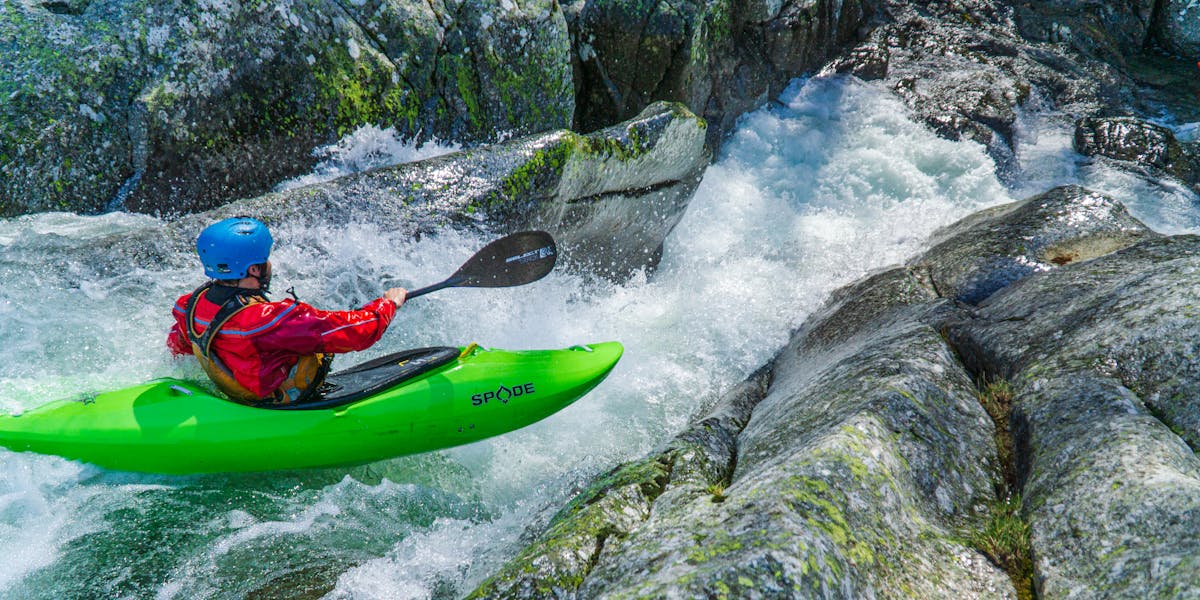
Starting Whitewater
Whitewater kayaking is one of the most thrilling outdoor sports — and one that requires specific safety knowledge and equipment that differs significantly from recreational kayaking. This guide covers what you need to get started safely on Class I-III whitewater.
Choosing Your Boat
Whitewater kayaks are shorter (6-9'), more rockered (curved), and more maneuverable than recreational or touring kayaks. They're designed to bounce over obstacles, self-drain, and roll upright after a capsize.
- River runners: Best for beginners to intermediate. Handles Class I-IV, predictable behavior. Jackson Kayak Zen, Dagger Juice.
- Playboats: Designed for technical moves (spins, loops, cartwheels) in specific features. Not for beginners.
- Creek boats: High-volume, designed for steep, technical Class IV-V. Large wave-shedding hull. Not for beginners.
Paddles
Whitewater paddles are shorter (194-200cm), stiffer, and more durable than touring paddles. Blade shape matters: high-angle blades for power moves; low-angle for relaxed river running.
Werner Sherpa, Aqua-Bound Sting Ray Carbon, and Bending Branches Ranche are popular river-runner choices. Expect to spend $150-300 on a quality paddle — it's worth the investment for its impact on control and fatigue.
Safety Equipment
- PFD (Personal Flotation Device): Type III whitewater-specific PFD (NRS Ninja, Astral V-Eight). Mandatory. Must fit snugly — not the same as a kayak touring PFD.
- Whitewater helmet: Covers temples and ears. ASTM F1492-certified. Protex Flow, Sweet Protection Rocker — ~$60-120.
- Throw bag: 50-70 foot rope in a bag for rescuing swimmers. Every paddler in your group should carry one.
- River knife: Fixed-blade knife mounted on PFD for cutting entangled lines. NRS Co-Pilot, Immersion Research.
- Dry bag: For car keys, phone, emergency supplies.
Clothing & Drysuits
Immersion risk on whitewater is high — dress for the water temperature, not the air temperature:
- Summer warm water (above 60°F): Wetsuit (2-3mm) or quick-dry layers + splash jacket.
- Cold water (below 60°F): A drysuit is strongly recommended. Kokatat Meridian, NRS Extreme Relief. Drysuits ($500-1,500) are a major safety investment for cold-water paddlers, alongside instruction, a fitted PFD, and conservative river choices.