What Mid-Handicappers Actually Need From Irons
Mid-handicappers (roughly 10-18 handicap) occupy an interesting position in golf equipment. You've moved beyond absolute beginner territory — you can make reasonable contact, understand basic ball flight, and have developed swing tendencies — but you're not yet consistent enough for the minimal-offset, thin-topline blades that better players prefer.
The equipment mistake most mid-handicappers make is buying irons that are either too forgiving (high-launch game improvement irons with massive offset that fight natural swing development) or too demanding (players irons that punish the off-center strikes that still happen regularly at this skill level). The sweet spot — literally and figuratively — is the players distance category.
Game Improvement vs Players Distance: What's the Difference?
The iron market has effectively bifurcated into two categories for mid-handicap golfers:
Game Improvement (GI) irons feature large cavity backs, significant offset (the leading edge is set back from the hosel), wide soles, and are engineered to launch the ball high and straight even on poor strikes. The Ping G730, Cleveland Launcher XL, and Wilson Dynapower are in this category. They're extremely forgiving but lack the feedback and workability that developing golfers need to improve.
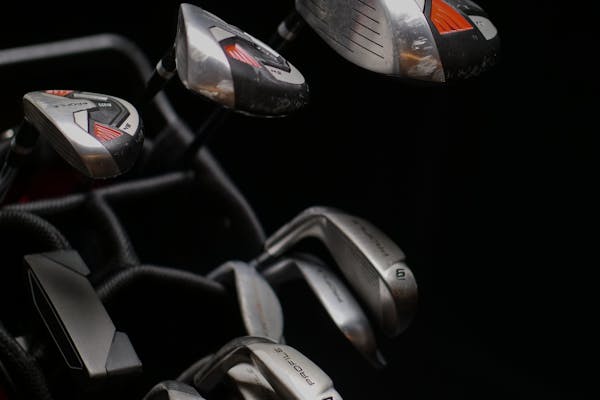
Players Distance (PD) irons are the modern evolution that changed the market. Hollow-body construction, AI-designed face inserts, and tungsten weighting allow manufacturers to build irons that look like players clubs (minimal offset, thinner topline, compact head) but perform like game improvement irons in terms of distance and forgiveness on off-center strikes. The Titleist T200, TaylorMade Qi10, Callaway Paradym Ai Smoke, and PING i530 are the leading examples.
Iron Construction Technology Explained
Modern irons use several construction innovations to optimize performance. Understanding these helps you evaluate marketing claims critically:
| Technology | What It Does | Benefit |
|---|---|---|
| Hollow Body | Air cavity inside the head allows thinner, faster face | Higher ball speed, more distance |
| Tungsten Weighting | Dense tungsten positioned precisely in the head | Lower CG for easier launch, higher MOI |
| Face Insert (urethane) | Soft insert behind face controls vibration | Better sound/feel, face speed optimization |
| Speed Pocket | Undercut slot at the sole flexes at impact | More ball speed on low-face strikes |
| AI Face Design | Variable thickness mapped across the face | Consistent ball speed across off-center hits |
| Muscle Back (forged) | Solid forged carbon steel | Superior feel, but less forgiving |
Top Iron Picks for Mid-Handicappers 2026
Callaway Paradym Ai Smoke Irons EDITOR'S CHOICE
Callaway's AI face design (trained on 35,000+ face architectures) creates variable thickness across the face that maintains ball speed even on off-center strikes. The hollow-body construction with a urethane microsphere insert delivers the sound and feel of a blade with game-improvement performance. Visually compact — indistinguishable from a players iron at address.
~$1,099 (set of 7) Check Price on Amazon
The TaylorMade Qi10 is among the longest-hitting mid-handicap irons in independent testing. The cap-back design (a sealed hollow body) combined with the Speed Pocket at the sole generates exceptional ball speed particularly on low-face impacts — exactly where most mid-handicappers tend to miss.
The PING i530 is the choice for mid-handicappers who want a more traditional feel. PING uses a forged face insert with a steel body, giving the i530 a crisper, more workable feel than the hollow-body competitors. It's slightly less forgiving on extreme misses but provides better feedback for golfers actively trying to improve their contact quality.
Best Budget Iron for Mid-Handicappers
The Cleveland Launcher XL Halo ($699 for a set of 8) is the best value option if new premium irons are out of budget. The "Halo" construction uses a hollow face with a steel body — delivering game-improvement forgiveness at a price that undercuts the premium market by 30-40%. Club testers consistently rate it as performing comparably to mid-range game improvement irons costing $200 more.
Cleveland Launcher XL Halo Irons BEST VALUE
Premium hollow-face technology at a significantly lower price than Callaway or TaylorMade. Excellent for mid-handicappers who want forgiveness without a four-figure investment.
~$699 (8-iron set) Check Price on Amazon
Full Comparison: Best Mid-Handicap Irons 2026
| Iron | Price (7-set) | Category | Construction | Best For |
|---|---|---|---|---|
| Callaway Paradym Ai Smoke | ~$1,099 | Players Distance | Hollow body + AI face | Distance + forgiveness balance |
| TaylorMade Qi10 | ~$1,099 | Players Distance | Cap back hollow | Maximum distance priority |
| PING i530 | ~$1,149 | Players Distance | Forged face + steel body | Feel + feedback seekers |
| Titleist T200 | ~$1,249 | Players Distance | D+ hollow face | Brand preference, premium feel |
| Cleveland Launcher XL Halo | ~$699 | Game Improvement | Hollow face + steel | Budget-conscious buyers |
Do You Need a Club Fitting for Irons?
For mid-handicappers buying irons at $800+, yes — a fitting is nearly always worth it. A standard iron fitting takes 45-60 minutes and measures shaft flex, shaft weight, lie angle, grip size, and head preference. Studies consistently show that fitted golfers hit significantly more greens in regulation than those playing stock specifications.
The most critical fitting variables for mid-handicappers are shaft flex (most mid-handicappers are over-shafted — playing stiff when regular or even senior flex would launch better) and lie angle (too upright or too flat changes the direction the ball starts). Both are free to adjust at most club fitting sessions.
Sources & Further Reading
- MyGolfSpy Most Wanted Iron Test 2025 — mygolfspy.com
- Golf Digest Hot List 2025 — golfdigest.com
- Titleist T200 Technical Specification Sheet (Titleist, 2025)
- TaylorMade Qi10 R&D Report (TaylorMade, 2025)
- USGA Rules of Golf — Club Specification Guidelines (2024)
🏈 Cobra Irons: Best Game-Improvement Pick for Mid-Handicappers
Cobra's AEROJET MAX irons are consistently rated the top game-improvement iron for mid-handicappers — wider sole, hollow-body construction, and PWR-COR technology push forgiveness without sacrificing distance. Puma/Cobra run regular sales and carry the full set including individual replacements.