Band Types Explained
Resistance bands are not interchangeable. The three primary types — mini loop bands, tube bands with handles, and large flat loop bands — have distinct construction, resistance profiles, and best-fit training applications. Buying the wrong type for your goals means leaving significant training value on the table.
Natural latex provides the most consistent resistance curve and the longest lifespan. TPE (thermoplastic elastomer) bands are latex-free alternatives but typically have shorter service life. Fabric-covered mini loops eliminate the snapping and rolling issues of bare latex on skin — relevant specifically for glute work.
Mini Loop Bands (Short Loop / Glute Bands)
Mini loop bands are 10–12 inch closed loops, typically 2–3 inches wide. They sit around the thighs, ankles, or wrists and create lateral or rotational resistance. Primary uses: glute activation, lateral band walks, clamshells, monster walks, banded squats for valgus correction, and banded hip thrusts.
Fabric mini loops (often called "booty bands" or "hip bands") are worth the premium over bare latex if you plan to use them directly on skin or thin leggings — the fabric backing prevents the rolling and pinching that affects bare latex bands during hip thrusts and squats.
Power Systems Fabric Hip Bands EDITOR'S CHOICE
Fabric-wrapped latex core eliminates the rolling and slipping problems of bare latex on skin. The 3-inch width distributes load across a larger surface area — significantly more comfortable during hip thrusts and standing clamshells than narrow latex bands. Available in three resistance levels; we recommend buying all three.
Tube Bands with Handles
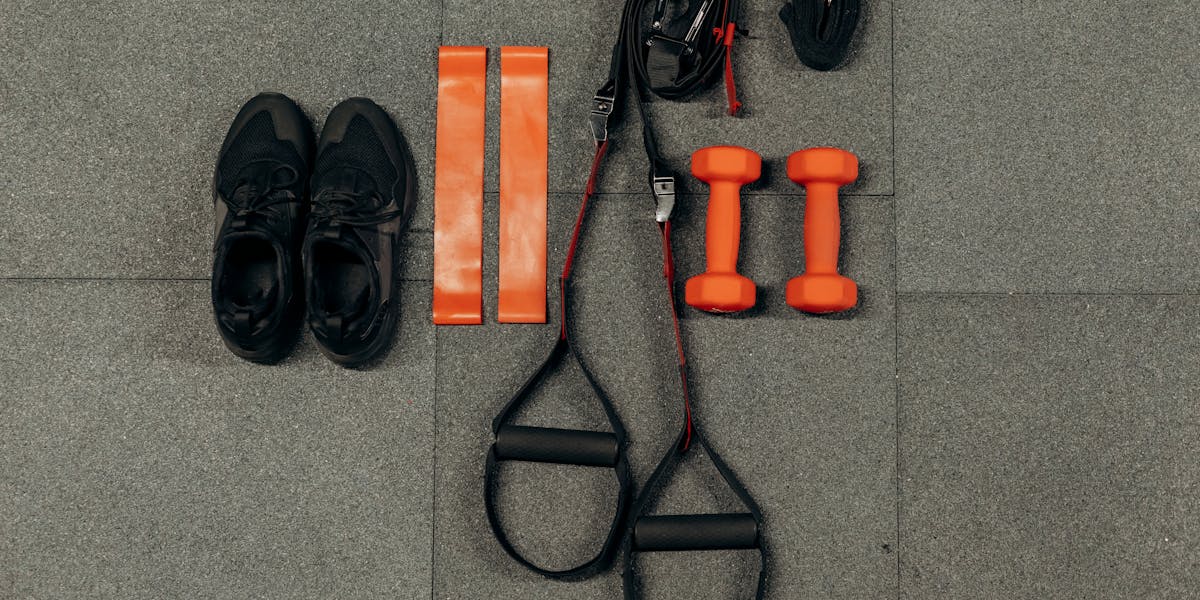
Tube bands are the style most people picture when they hear "resistance bands": a cylindrical latex or rubber tube with plastic or foam handles at each end, and usually a door anchor in the kit. They mimic cable machine exercises — bicep curls, tricep pushdowns, chest flyes, shoulder raises, and rows — and are the most portable form of upper body resistance training.
| Resistance Level | Color | Equivalent Dumbbell Weight | Best For |
|---|---|---|---|
| X-Light | Yellow | 2–5 lb | Shoulder rehab, warm-up |
| Light | Green | 5–15 lb | Shoulder exercises, lateral raises |
| Medium | Red | 15–25 lb | Bicep curls, tricep pushdowns |
| Heavy | Blue | 25–40 lb | Rows, chest press, squats |
| X-Heavy | Black | 40–60 lb | Deadlift simulation, loaded carries |
Large Flat Loop Bands (Pull-Up / Power Bands)
Large flat loop bands — sometimes called power bands, monster bands, or pull-up assistance bands — are full-length (40–41 inch) flat latex loops ranging from 1/2 inch wide (light, ~5–35 lb) to 2.5 inches wide (extra heavy, ~50–150 lb). They are used for three main purposes: assisted pull-ups and dips (looped under the foot or knee), resistance in barbell training (band tension added to deadlifts and squats), and heavy mobility and stretching work.
For barbell band tension: looping a heavy band around the barbell plates and anchoring it to the floor or rack base adds 20–80 lb of accommodating resistance at lockout. This forces maximal effort through the full range of motion and is a standard technique in powerlifting periodization (Westside Barbell method).
Full Type Comparison
| Band Type | Shape | Primary Use | Resistance Range | Best For |
|---|---|---|---|---|
| Mini Loop | Short closed loop | Glute activation, lateral work | 5–50 lb | Lower body, rehab |
| Fabric Mini Loop | Short fabric-covered loop | Hip thrusts, glute isolation | 15–60 lb | Glute-focused training |
| Tube w/ Handles | Tube with handles | Upper body cable replacements | 5–60 lb | Home/travel upper body |
| Large Flat Loop | Full-length flat loop | Pull-up assist, bar tension | 5–200 lb | Pull-up progressions, powerlifting |
Top Picks 2026 by Use Case
Power Systems Complete Band Kit (Best Value Set) BEST VALUE
A complete set covering all three band types — mini loops, tube bands with handles and door anchor, and one large flat loop for pull-up assistance — gives you an all-purpose resistance training toolkit for under $80. This is the smartest single resistance band purchase if you are starting fresh and want maximum exercise variety without buying three separate sets.
Sources & Further Reading
Reviewed May 29, 2026. Source notes emphasize current public-health guidance, product-safety notices, manufacturer specifications, and peer-reviewed research behind this guide.
- Journal of Strength and Conditioning Research — Band vs Free Weight Resistance Profiles (2024)
- NSCA — Accommodating Resistance in Strength Training
- Power Systems Product Specifications (powersystems.com)
- TSP Lab — Resistance Band Durability Testing Protocol, 2026
- ACSM - resistance exercise for health
- American Heart Association - strength and resistance training
- CDC - adult physical activity guidance
- U.S. CPSC - exercise equipment recalls