What the Science Shows
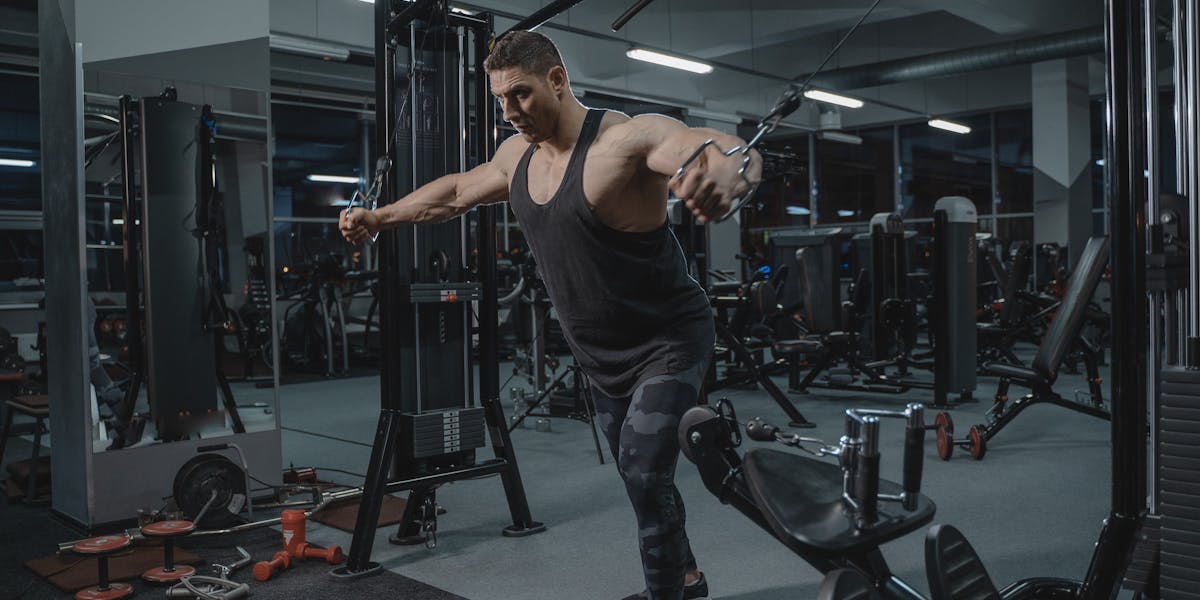
The cable vs free weight debate has been studied extensively in sports science. The summary: both build muscle effectively, but they create different training stimuli. Free weights (barbells, dumbbells) require more stabilizer muscle activation because you're controlling the implement in 3D space. Cables provide constant tension throughout the full range of motion because the resistance is always pulling toward the pulley.
| Factor | Free Weights | Cable Machine |
|---|---|---|
| Stabilizer activation | Higher | Lower (by design) |
| Constant tension | Variable (gravity-dependent) | Constant throughout ROM |
| Range of motion | Limited by anatomy | Fully adjustable |
| Compound strength | Superior | Good but secondary |
| Injury risk (beginners) | Higher (form-dependent) | Lower (guided path) |
| Muscle isolation | Difficult | Excellent |
Muscle Activation Differences
EMG studies comparing cable vs free weight variations show interesting differences by exercise. In bench press variations, free weight bench activates stabilizers ~20% more than cable fly alternatives. But in tricep pushdowns vs close-grip bench press, cables maintain tension through the full elbow extension where the free weight has minimal tension at lockout.
For chest development, research suggests combining both: barbell bench for maximal loading and structural strength, cable flys for full-ROM constant tension that free weights can't replicate. The same logic applies across most muscle groups.
Rogue SML-2 Squat Stand + Pulley Attachment EDITOR'S CHOICE
For home gym builders, Rogue's pulley system attaches to any Monster or SML-series rack to add cable functionality without a separate machine. Pair with a set of adjustable dumbbells and you have a complete home gym under $1,500 total.
~$350 Check Price on Amazon
Best Exercises for Each Modality
Free weights win for:
- Squat, deadlift, bench press, overhead press — maximal loading compound movements
- Olympic lifts (clean, snatch) — require free implement
- Dumbbell exercises — unilateral work, rotational movements
Cables win for:
- Lateral raises — cables provide constant tension at bottom of movement where dumbbells have none
- Cable flys — full ROM chest stretch with constant resistance
- Face pulls — no good free weight alternative
- Tricep pushdowns, cable curls — better tension curve than free weight alternatives
Bowflex SelectTech 552 Adjustable Dumbbells BEST VALUE
Replace 15 pairs of dumbbells in one footprint. Adjusts from 5 to 52.5 lbs in 2.5 lb increments. The most space-efficient free weight solution for home gyms. Build the foundation of your free weight training without a full rack of dumbbells.
~$300 Shop Power Systems
Home Gym Considerations
Budget matters. A quality cable machine starts at $500 (functional trainer) and goes to $3,000+. A complete free weight setup (power rack + barbell + plates) runs $600–1,200 and covers the majority of compound movements. For most home gym builders, the recommendation is: free weights first, cable attachment second.
Recovery: The Missing Variable
Strength gains happen during recovery, not during the workout. Yet most gym-fitness setups overlook recovery tools entirely. A quality back roller addresses the thoracic tightness that accumulates from heavy pressing and pulling sessions.
Chirp Wheel+ (3-Pack) EDITOR'S CHOICE
Recovery is half the training equation. The Chirp Wheel+ sits in a groove specifically designed for the spine, targeting deep back muscles and thoracic mobility that foam rollers miss entirely. The 3-pack covers deep tissue (4"), medium (5"), and gentle (6") pressure — use after any heavy cable or free weight session to reduce DOMS and maintain range of motion.
~$100 Check current Chirp Wheel back roller deals Shop Chirp
The Verdict
Neither machine is definitively better — they're complementary. If you could only have one: free weights build more functional strength and have better carryover to athletic performance. If you're in a commercial gym: use both. Program free weights for compound movements and cables for isolation and constant-tension work.
The science supports this approach — programs using both modalities show greater overall muscle development than programs using either alone.
Sources & Further Reading
Reviewed May 29, 2026. Source notes emphasize current public-health guidance, product-safety notices, manufacturer specifications, and peer-reviewed research behind this guide.