Fast answer for "rock climbing shoes buying guide"
Beginners should start with a comfortable neutral or moderate shoe that can stay on for multiple routes. Painful downsizing is not a shortcut to better footwork.
| Reader | First Check | Why It Fits | Buy Zone |
|---|---|---|---|
| New climber | Neutral comfort shoe | Comfort keeps you practicing footwork instead of ripping shoes off between climbs. | Avoid pain-fit |
| Gym boulderer | Moderate velcro shoe | A little downturn and easy on/off can help without overbuying. | Try in store |
| Sport climber | Edging + sensitivity balance | Rubber, shape, and midsole stiffness should match route style. | Check route type |
| Wide/narrow feet | Brand fit first | La Sportiva, Scarpa, Black Diamond, and Mad Rock fit differently. | Use returns |
| Advanced buyer | Aggressive specific shoe | Performance shoes solve specific problems after footwork is stable. | Do not rush |
If you searched "climbing shoes," do not buy by model hype first
The page now puts fit, shoe shape, closure, rubber, and use case ahead of generic product links.
Climbing shoe fit and model retailer option
Climbing shoes are fit-sensitive. Use fit guides and brand pages before treating a marketplace listing as the right size.
Climbing shoe decision matrix
Use this before choosing a size or model.
The Three Categories of Climbing Shoes
Climbing shoes fall into three main performance categories: neutral, moderate, and aggressive. These classifications describe the overall geometry, stiffness, and intended use case of the shoe.
Neutral shoes have a flat, comfortable last that closely resembles a normal foot shape. They're designed for all-day comfort, multi-pitch routes, crack climbing, and beginners learning footwork fundamentals. You can wear them for hours without significant foot pain.
Moderate shoes have a slight downturn and a stiffer sole that provides better power transfer on small edges. They're the workhorses of the climbing shoe world — precise enough for technical sport routes while remaining comfortable enough for extended sessions.
Aggressive shoes have a pronounced downturn and often a highly asymmetric shape that concentrates power on the big toe. They're designed for steep, overhanging bouldering and sport climbing, but become uncomfortable within 15–30 minutes. Most beginners should avoid them.
Downturn Explained: Flat vs Moderate vs Cambered
Downturn describes how aggressively the toe box curves downward relative to the heel. It determines where your power concentrates when you stand on a foothold.
| Downturn Type | Best For | Comfort Level | Performance Level |
|---|---|---|---|
| Flat (0°) | Crack climbing, slabs, multi-pitch, beginners | All day | Moderate |
| Slight (-5° to -10°) | Sport routes, gym bouldering, all-around | 2–4 hours | Good |
| Moderate (-10° to -15°) | Technical sport routes, moderate overhangs | 1–2 hours | High |
| Aggressive (-15°+) | Steep bouldering, overhanging sport routes | 15–30 min | Very High |
Asymmetry also matters. A highly asymmetric shoe pulls all toes toward the big toe, concentrating power for steep heel hooks. Symmetrical shoes are more comfortable and better for edging on vertical terrain.
Closure Systems: Lace vs Velcro vs Slipper
Lace closures offer the most customizable fit — you can tighten the toe box and heel independently. Preferred for all-day comfort and crack climbing. Slower to put on and remove.
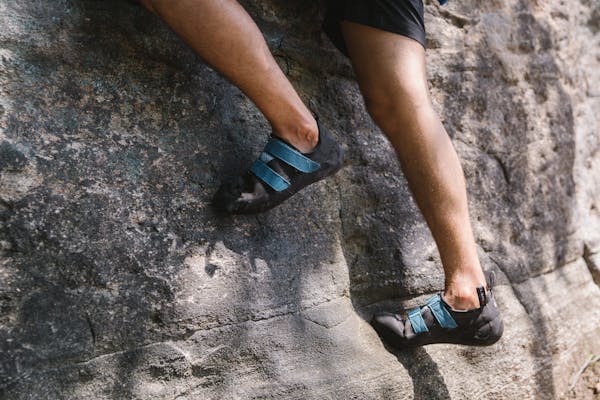
Velcro closures are fast on/off, making them ideal for gym bouldering where you're slipping them off between problems. Fit adjustability is limited but usually adequate.
Slippers have no closure — just a tight elastic rand. They're the most sensitive option, pack flat, and work well for gym bouldering or precise technical climbing. They require a noticeably tighter fit to stay on the foot.
Rubber Compounds: Stiff vs Soft
Rubber compound determines friction, durability, and edge performance. The two dominant systems are La Sportiva's FriXion family and Scarpa's XS Grip/XS Edge compounds.
Soft rubber (e.g., FriXion RS, XS Grip2) offers high friction on slabs and natural rock but wears faster. It's forgiving of imprecise technique — the rubber "sticks" even with poor placement.
Stiff rubber (e.g., XS Edge) has less flex, making it better for standing on tiny edges for extended periods. It transmits foot force more directly to the foothold, reducing fatigue on long technical routes.
Fit and Sizing: The Most Important Decision
Climbing shoe fit is the single most debated topic in the sport. Modern thinking has shifted away from the "as tight as possible" approach toward fit that enables precise footwork without causing injury.
For neutral shoes, aim for a snug fit where toes touch the end of the shoe with minimal curl. For moderate shoes, a small amount of toe curl (less than half the joint) is acceptable. For aggressive shoes, more curl is standard, but the shoe should never cause numbness or severe pain while climbing.
Leather shoes stretch 1–2 full sizes over break-in. Synthetic shoes stretch far less — typically half a size or less. Size leather shoes tighter than expected; size synthetic shoes closer to street shoe size.
Top Picks 2026
La Sportiva Tarantulace EDITOR'S CHOICE — BEGINNER
The Tarantulace remains the most recommended beginner shoe year after year. The leather upper breaks in predictably, FriXion RS rubber has genuine grip on both natural rock and gym volumes, and the lace closure allows a custom fit. Not the most sensitive shoe, but for learning technique on vertical routes, it's near-perfect.
Scarpa Instinct VS BEST VALUE — INTERMEDIATE
The Instinct VS hits the sweet spot for intermediate climbers ready to move beyond neutral shoes. The moderate downturn handles technical sport routes and gym bouldering well, while XS Grip2 rubber provides excellent friction on a variety of surfaces. Velcro closure is convenient for repeated project attempts. Sizing tends to run small — try half a size up from your usual Scarpa size.
La Sportiva Solution Comp EDITOR'S CHOICE — ADVANCED
The Solution Comp is the aggressive performance benchmark. The pronounced downturn, asymmetric last, and P3 platform maintain the shape under load. XS Grip2 rubber with a 4mm sole provides precise feedback on steep pockets. These are precision instruments for hard bouldering and sport routes — wear them only while actively climbing.
Sources & Further Reading
Reviewed June 5, 2026. Source notes emphasize climbing context, movement demands, and sports-injury considerations for footwear fit.