Fast answer for "futsal vs indoor soccer shoes"
Futsal shoes are indoor/court shoes with flat rubber outsoles. Indoor soccer can mean futsal court, hardwood, sport court, concrete, or short indoor turf, so the surface label matters.
| Reader | First Check | Why It Fits | Buy Zone |
|---|---|---|---|
| Futsal court | IC/futsal shoe | Flat rubber outsole fits the court game and ball-control demands. | Nike/adidas indoor paths |
| Hardwood or sport court | Non-marking indoor/court outsole | Studded turf shoes can mark floors or feel unstable. | Check facility rule |
| Indoor turf | TF turf shoe | Short turf needs distributed rubber nubs instead of a flat court sole. | Use TF label |
| Outdoor artificial grass | AG or MG cleat | Artificial grass is not the same as indoor turf or futsal court. | Use brand surface label |
| Youth/recreation | Returnable IC or TF shoe | Facilities use 'indoor soccer' differently; confirm surface before final purchase. | Avoid one-pair assumptions |
If you searched "difference between indoor soccer shoes and turf shoes," look at the sole
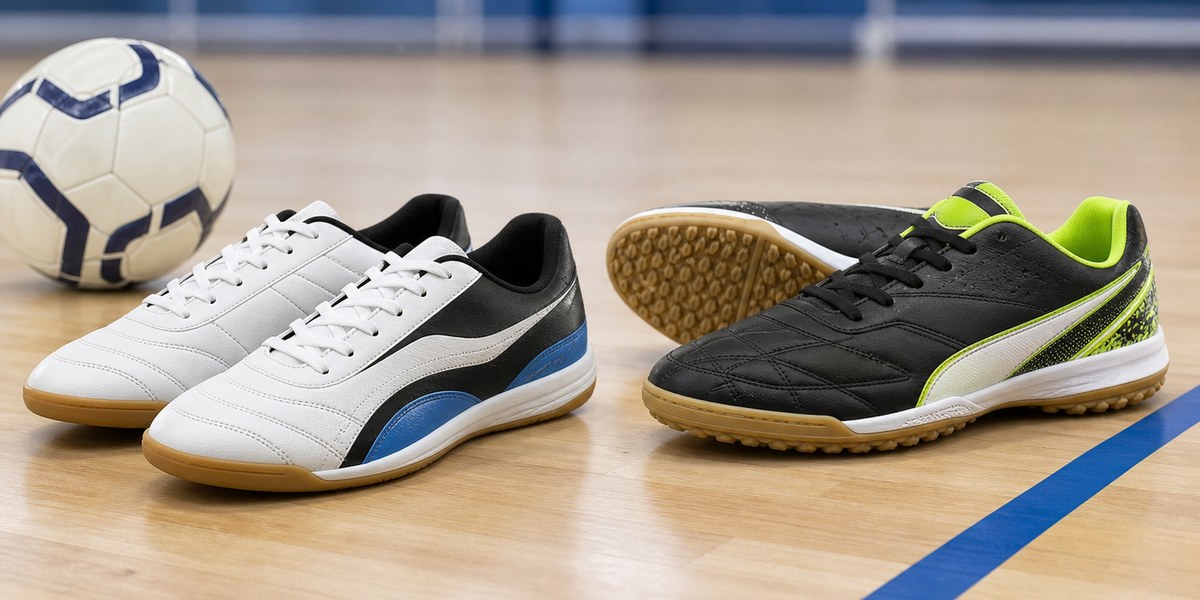
The difference is underfoot: flat IC/futsal soles for courts, TF nubs for indoor turf, and AG/MG/FG cleats for outdoor field surfaces.
Futsal and indoor soccer footwear retailer option
The right answer depends on whether the facility is a futsal court, sport court, concrete, carpet turf, or deeper artificial grass.
Futsal vs indoor shoe matrix
Use this when a league signup just says 'indoor soccer.'
Court Surface Differences
The terms futsal and indoor soccer are often used interchangeably, but the surfaces they reference are different, and shoe requirements follow from the surface.
Futsal Courts: played on hard, flat surfaces — hardwood gym floors, polished concrete, or specialized sport court tiles. Similar to a basketball court: low friction, smooth, completely flat. Ball bounce is minimal (futsal balls are specifically low-bounce). Game played in enclosed spaces, typically 40x20 meters.
Indoor Soccer (Turf / 3G Halls): in North America, indoor soccer often refers to the game played on short-pile artificial turf inside a domed or indoor facility. This turf surface is similar to outdoor 3G artificial grass but with shorter pile and firmer base. It provides significantly more traction than hard courts and a completely different feel underfoot.
This distinction matters: a futsal flat-sole shoe has insufficient grip on indoor turf, while a turf shoe (small rubber studs) will damage a hardwood gym floor and provides too much grip on smooth surfaces.
Futsal Shoes Explained
Futsal shoes are designed specifically for hard, flat, smooth courts. Their defining feature is the gum rubber or flat non-marking rubber outsole — completely flat, made of sticky rubber that generates friction through material grip rather than mechanical studs.
Outsole Geometry: the flat sole makes full contact with the smooth court surface. Some futsal shoes use a herringbone pattern in the rubber for multidirectional traction, similar to indoor basketball shoes. The rubber compound is typically softer and stickier than turf shoe rubber — optimized for sliding resistance on smooth surfaces.
Upper Construction: most futsal shoes use synthetic leather or knit upper that provides good ball feel and close fit without bulk. Low-profile construction keeps the foot close to the ground for stability during quick directional changes central to futsal play.
Cushioning: futsal involves significant impact from jumping and quick stops on hard surfaces. Better futsal shoes include responsive foam midsoles for impact absorption — a feature often absent in budget models. If you play futsal multiple days per week, cushioning quality is a meaningful comfort and injury-prevention factor.
Indoor Soccer Shoes (Turf)
Indoor soccer shoes for turf surfaces use a flat rubber outsole studded with dozens of small nubs (3–5mm height). This nub pattern provides grip on synthetic turf fibers without penetrating too deeply.
Why not use outdoor turf shoes? Outdoor turf shoes are designed for slightly more aggressive traction on longer-pile turf with a rubber substrate. Indoor turf typically has shorter pile on a harder base — outdoor turf shoes can over-grip, increasing knee and ankle stress during cuts. Indoor turf-specific shoes have a lower nub height optimized for denser, shorter indoor turf.
Surface Versatility: many players use turf shoes across multiple surfaces — indoor turf, concrete, asphalt. The rubber nubs handle this versatility better than grass-specific cleats. However, using turf shoes on smooth hardwood (futsal) courts provides inadequate grip and risks damaging the floor surface.
Sole Type Quick Reference
| Surface | Sole Type | Description |
|---|---|---|
| Futsal (hardwood/smooth) | IC / IN (Flat Gum Rubber) | Non-marking flat rubber, herringbone pattern, max contact area |
| Indoor Turf (short pile) | TF (Turf) | Small rubber nubs, 3–5mm height, distributed contact |
| Hard outdoor surfaces | TF (Turf) | Works on concrete, asphalt, and hard packed earth |
| 3G outdoor turf | AG / TF | AG preferred; TF works but provides less grip |
Top Picks for Futsal and Indoor Soccer 2026
Best Futsal Shoe: Nike Phantom GX 2 Academy IC
Nike Gripknit upper provides excellent ball feel for the first-touch-intensive futsal game. The gum rubber IC outsole is one of the stickier compounds in the category — exceptional on polished hardwood and sport court surfaces. Low profile collar for agility. Check Nike Phantom IC shoes
Best Value Futsal Shoe: Adidas Copa Gloro IN
Kangaroo leather toe box delivers premium ball feel at a mid-range price. The Copa IC outsole has been refined over decades of futsal play. Excellent for players who prioritize touch on smooth court surfaces. Check adidas Copa indoor shoes
Best Indoor Turf Shoe: Puma King Ultimate TT
Leather upper and clean silhouette for control. The TT outsole uses a distributed nub pattern that performs reliably on indoor turf in both dry and slightly damp conditions. Great for players who split time between indoor and occasional outdoor training. Check soccer shoe surface labels
Frequently Asked Questions
Sources & Further Reading
Reviewed June 18, 2026. Source notes emphasize player footwear legality, field surfaces, football turf, futsal surfaces, and surface-specific traction.