ⓘ This article contains affiliate links. If you purchase through our links, we may earn a commission at no extra cost to you. Full disclosure →
Transition Basics
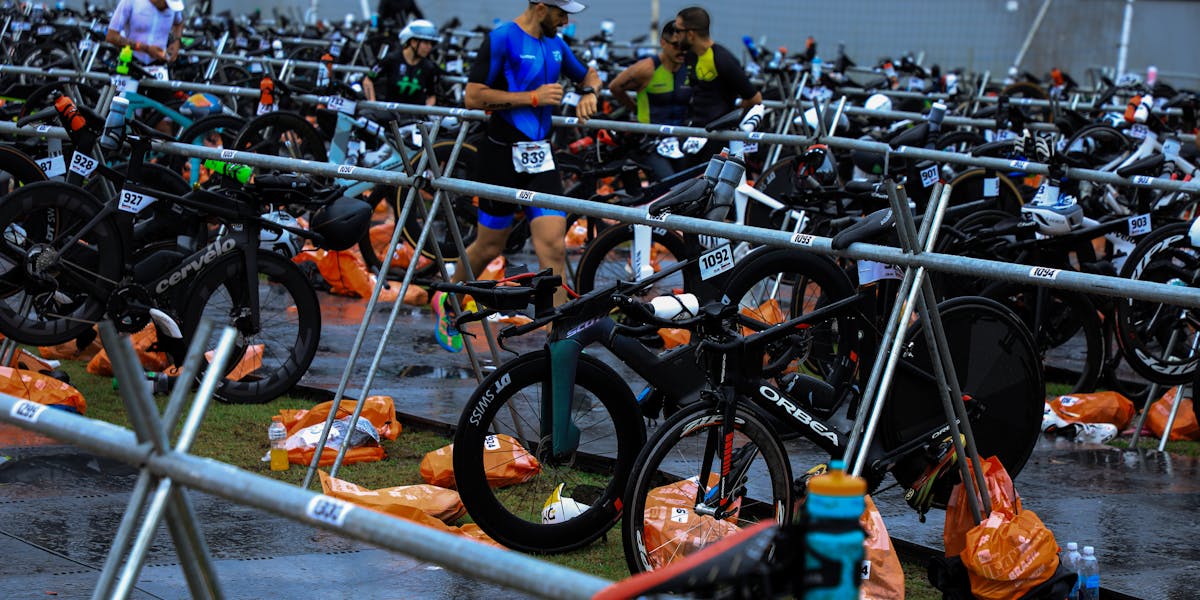
For most age-group triathletes, 2-4 minutes are lost in transitions per race. Sprint triathletes who consistently finish in the top 10% of their age group typically have sub-90-second transitions. The gear you choose and how you organize it determines how much time you leave on the table.
Key principle: practice your transitions at home before race day. Running through T1 and T2 choreography 5-10 times eliminates the panic of race-day first-time execution.
T1: Swim to Bike
- Wetsuit strippers: Pay the $3-5 fee at Ironman events — volunteers strip your wetsuit in 3 seconds flat.
- Triathlon shoes: For sprint/Olympic: shoes already on the bike pedals (flying mount saves 15-30 seconds). For Ironman: shoes on the ground beside the bike — more reliable, especially on hills.
- Race belt: Nathan SpeedDraw Race Belt — clip on in 2 seconds while running to your bike, rather than fiddling with bib pins.
- Helmet: On top of your bike stack, facing so you can put it on quickly. Sunglasses pre-loaded inside the helmet.
- Bike nutrition: Water bottles and gels pre-loaded on the bike. Don't lose transition time loading nutrition.
T2: Bike to Run
- Running shoes: Elastic laces (Xtenex, Lock Laces) eliminate tying and save 15-30 seconds.
- Run hat or visor: Pre-positioned on top of shoes for quick grab.
- Number belt: Already attached from T1 — flip bib to front for the run.
- Nutrition and hydration: Pick up run nutrition from the transition bag, not a separately organized spot.
Time-Saving Gear
Nathan Race Belt — Best transition gear for triathlon. Holds race number, bib clips on in 2 seconds, elastic fit over any kit. Saves 1-2 minutes vs pin-on bib.
TSP deal watch path
Xtenex Sport Laces (Elastic Laces) — Best elastic laces for triathlon T2. Patented knot system maintains tension, no tying needed. 20 colors, fits all shoes. Standard for Ironman.
TSP deal watch path
Garmin HRM-Pro Plus Heart Rate Monitor — Best triathlon heart rate strap. ANT+ and Bluetooth, running dynamics, swim-safe, compatible with all Garmin and SRAM AXS devices.
TSP deal watch path
Transition Layout Tips
- Know your rack number before race day — visit transition the day before to visualize your location
- Lay a small bright-colored towel (yellow, orange) at your transition spot for easy visual identification
- Practice one-handed helmet buckle — most transition time is lost here
- Walk the run-out and bike-out paths before race start — know exactly where you're going
- In bike-mount zone: know exactly where the mount line is and practice the flying mount before race day if you're using it
Sources & Further Reading
Reviewed June 18, 2026. Source notes emphasize transition-area conduct, multisport rule compliance, and long-course race policy context.